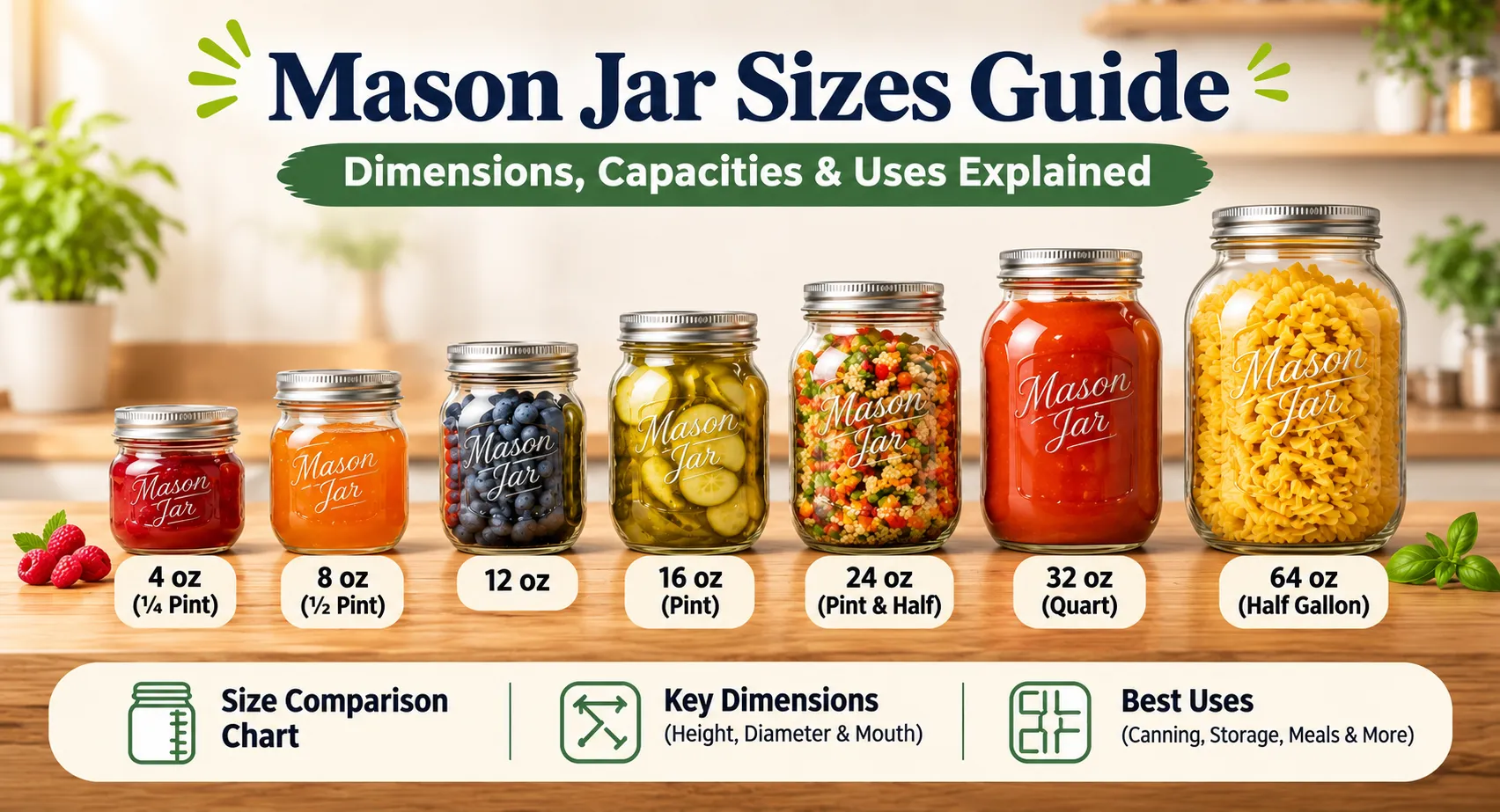
Mason Jar Sizes Guide: Dimensions, Capacities & Uses Explained
Mason jars come in all sorts of sizes, so they’re very useful for home canning, food storage, meal prep, drinks, and all sorts of other projects. You can have small jars for your homemade jams and jellies right up to the big ones for your pantry. The size you choose depends on what you’ll store and use them for.
However, capacity is only one element of the decision. Jar height, body diameter, mouth opening, and lid compatibility can all have an effect on how suitable a container is.
Mason Jar Sizes Chart: Complete Size Comparison
The easiest way to compare the various sizes of mason jars is to look at their capacities. The standard home canning jars will be half-pint, pint, pint and a half, quart and a half gallon. There are also several smaller jars available for jams, jellies, and such.
The following chart covers seven commonly available capacities.
| Mason Jar Size | Common Name | Capacity (US fl oz) | Capacity (ml) | Capacity (US Cups) | Common Uses |
| 4 oz | Quarter Pint | 4 oz | 118 ml | ½ cup | Jam, jelly, spices |
| 8 oz | Half Pint | 8 oz | 237 ml | 1 cup | Preserves, sauces, desserts |
| 12 oz | Specialty Size | 12 oz | 355 ml | 1½ cups | Marmalade, condiments |
| 16 oz | Pint | 16 oz | 473 ml | 2 cups | Pickles, salsa, beverages |
| 24 oz | Pint and a Half | 24 oz | 710 ml | 3 cups | Vegetables, meal preparation |
| 32 oz | Quart | 32 oz | 946 ml | 4 cups | Food storage, tomatoes, pantry goods |
| 64 oz | Half Gallon | 64 oz | 1,893 ml | 8 cups | Bulk storage, beverages, fermentation |
Understanding Mason Jar Measurements
- Capacity: The amount of liquid a jar is designed to hold, commonly expressed in US fluid ounces.
- Height: The vertical measurement from the base to the top rim.
- Body diameter: The width of the jar at its widest point.
- Mouth opening: The opening at the top, which determines how easily ingredients can be added or removed.
- Lid diameter: The size of the compatible lid and band.
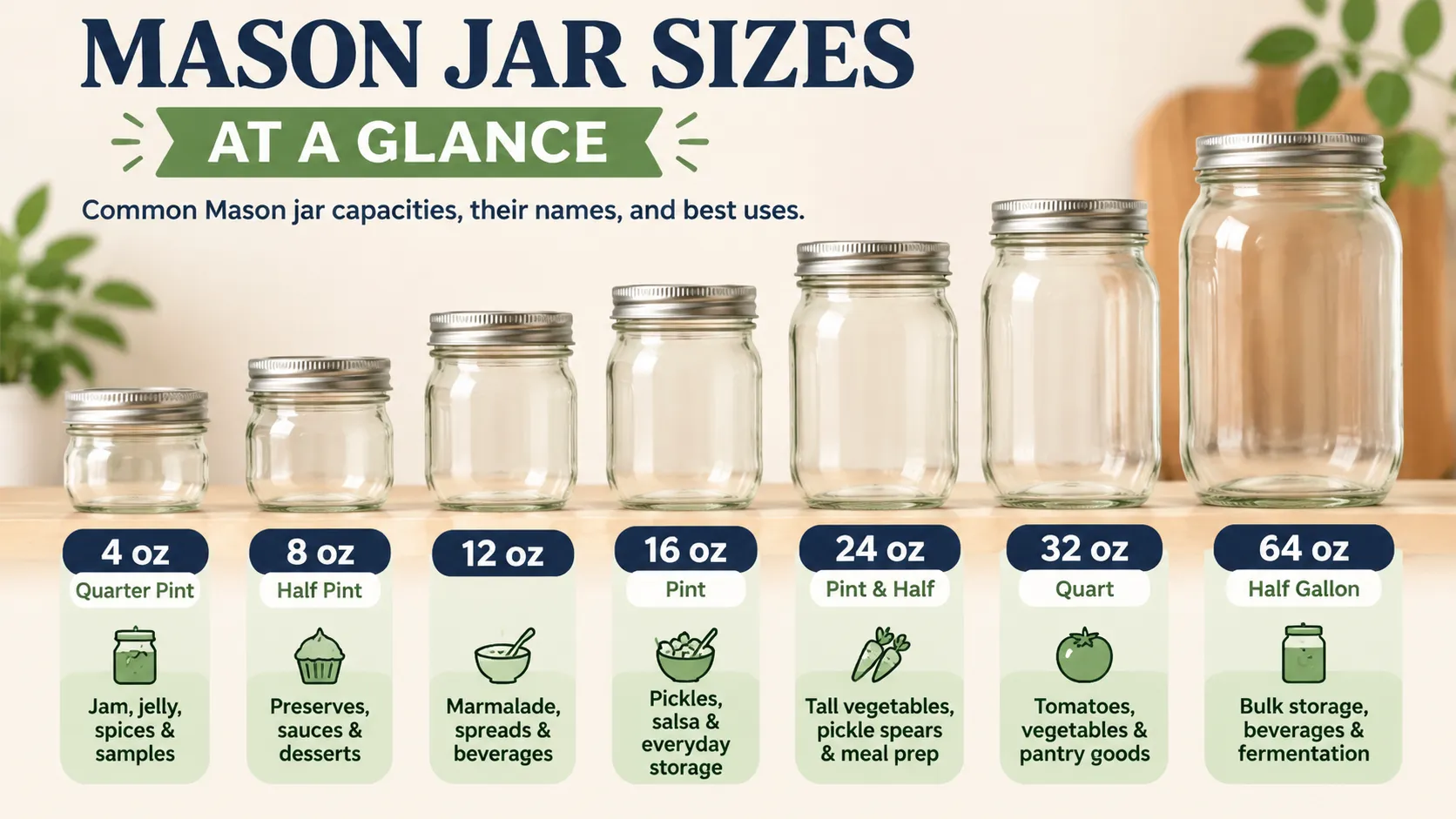
Different Mason Jar Sizes Explained
1. 4 oz Mason Jars (Quarter Pint)
The 4 oz. mason jar is one of the smallest of the traditional style of preserving jars. Its small size makes it ideal for small quantities of home-produced goods, for individual servings, and for gift-giving.
These are the jars that are absolutely ideal for homemade jams, jellies, honey, mustard, spice blends, and all sorts of other condiments. Their small size also makes them perfect for party favors and product samples.
- Homemade jam and jelly.
- Honey and specialty spreads.
- Small spice portions.
- Wedding and party favors.
- Condiments and product samples.
2. 8 oz Mason Jars (Half Pint)
The 8 oz. mason jar (the half-pint mason jar) is the one people most commonly use for home preserving and general food storage.
It has sufficient capacity for smaller runs without requiring a huge amount of storage space. They’re commonly used for jams, marmalades, chutneys, sauces, and individual desserts.
They can also be used for overnight oats, for yogurt, and for small amounts of meal prep.
- Jams and fruit preserves.
- Chutneys and sauces.
- Overnight oats.
- Individual desserts.
- Homemade food gifts.
3. 12 oz Mason Jars
The 12 oz. mason jar has more volume than a standard half-pint container and is smaller than a standard pint jar.
This specialty size is useful for marmalades, fruit spreads, homemade condiments, and a few beverage applications. It’s a sensible middle ground for people who want something bigger than an 8oz jar without going all the way up to a pint.
Availability and dimensions can vary significantly from manufacturer to manufacturer.
- Marmalades and fruit spreads.
- Homemade sauces.
- Condiments.
- Specialty food products.
- Small beverage portions.
4. 16 oz Mason Jars (Pint)
The 16oz mason jar (the so-called pint jar) is probably the most useful of all mason jars for home use.
It holds about 2 US cups and is quite capable of holding a range of food, drink, and other ingredients.
Pint jars are used for pickles, salsa, sauces, preserved veg, salads, overnight oats, and cold drinks.
They’re available in regular mouth and wide mouth versions, so you can select the opening that’s appropriate for your application.
- Homemade salsa and sauces.
- Pickles and preserved vegetables.
- Salads and meal preparation.
- Cold drinks and iced beverages.
- Dry food storage.
5. 24 oz Mason Jars (Pint and a Half)
The 24 oz. mason jar (also known as a pint and a half jar) provides extra capacity for ingredients that require more space than a standard pint jar.
Its larger capacity is, of course, ideal for storing vegetables, pickle spears, and all sorts of other things that you just need a bit more room for.
- Larger vegetables.
- Pickle spears.
- Meal preparation.
- Larger food portions.
- Soups and selected storage applications.
6. 32 oz Mason Jars (Quart)
It’s a very practical way of storing larger quantities of ingredients and preserving home produce. Quart jars are routinely used for pickles, tomatoes, fruit, veggies, broth, and all sorts of dry pantry goods.
Both the regular mouth and the wide-mouth quart jars are available, so it’s easy to pick the right opening for the food you’re storing.
- Pickles and preserved vegetables.
- Tomatoes and fruits.
- Dry pantry ingredients.
- Homemade broth and sauces.
- Larger salads and food storage.
7. 64 oz Mason Jars (Half Gallon)
The 64 oz. mason jar (also known as a half gallon) is one of the larger traditional home preservation formats. It’s about 8 US cups or 1.89 liters.
It has a generous capacity, so it is ideal for bulk storage and large volumes of beverages, cold brew coffee, and certain fermentation applications.
However, the half-gallon size has its limitations when it comes to home canning. Half gallons are generally only recommended for specific high-acid juices (apple and grape juice being the prime examples) where you have a tested recipe.
- Bulk dry food storage.
- Cold brew coffee.
- Large beverage batches.
- Fermentation projects.
- Approved apple and grape juice preservation.
Mason Jar Dimensions: Height, Diameter & Mouth Measurements
Mason Jar Sizes and Dimensions Chart
The following chart compares published height and outside
diameter measurements for selected glass mason jar models.
Measurements are in inches and refer to specific products.
So jars from other brands or collections may have different
dimensions.
| Jar Size | Jar Model / Mouth | Height | Outside Diameter |
|---|---|---|---|
| 4 oz | Ball Quilted, Regular | 2.25 in | 2.50 in |
| 8 oz | Ball, Regular | 4.00 in | 2.75 in |
| 12 oz | Mason Economy, 70-450 | 4.72 in | 2.92 in |
| 16 oz | Ball, Regular | 5.13 in | 3.38 in |
| 16 oz | Ball, Wide | 4.75 in | 3.25 in |
| 32 oz | Ball, Wide | 6.44 in | 3.38 in |
| 32 oz | Ball, Regular | 6.79 in | 4.13 in |
| 64 oz | Ball, Wide | 9.13 in | 4.50 in |
Note: Measurements are based on selected product specifications, not universal standards. Height and diameter may vary by manufacturer, jar design, and mouth style. The 12 oz example is a specialty Mason-style jar. A comparable traditional 24 oz model was not verified for this chart.
Capacity alone does not determine a jar’s physical dimensions. For example, regular-mouth and wide-mouth 16 oz pint jars can have different heights and widths despite holding the same nominal capacity.
Capacity, of course, is not the only thing that will determine whether a mason jar will work in your storage or with your preferred accessories.
Jar Height
Jar height determines how much vertical space the jar will take up.
Body Diameter
Body diameter is the jar’s diameter at its widest point.
Mouth Opening
The mouth opening will dictate how easily you can fill, empty, and clean the container.
Common Mason Jar Mouth Measurements
The two common US mason jar mouth styles have approximately these opening measurements:
| Measurement | Regular Mouth | Wide Mouth |
| Inner mouth opening | 2⅜ inches | 3 inches |
| Inner opening in mm | 60 mm | 76 mm |
| Approximate lid and band diameter | 70 mm | 86 mm |
| Suitable applications | Jams, sauces, liquids | Vegetables, pickles, meal prep |
Regular Mouth vs. Wide Mouth Mason Jar Sizes
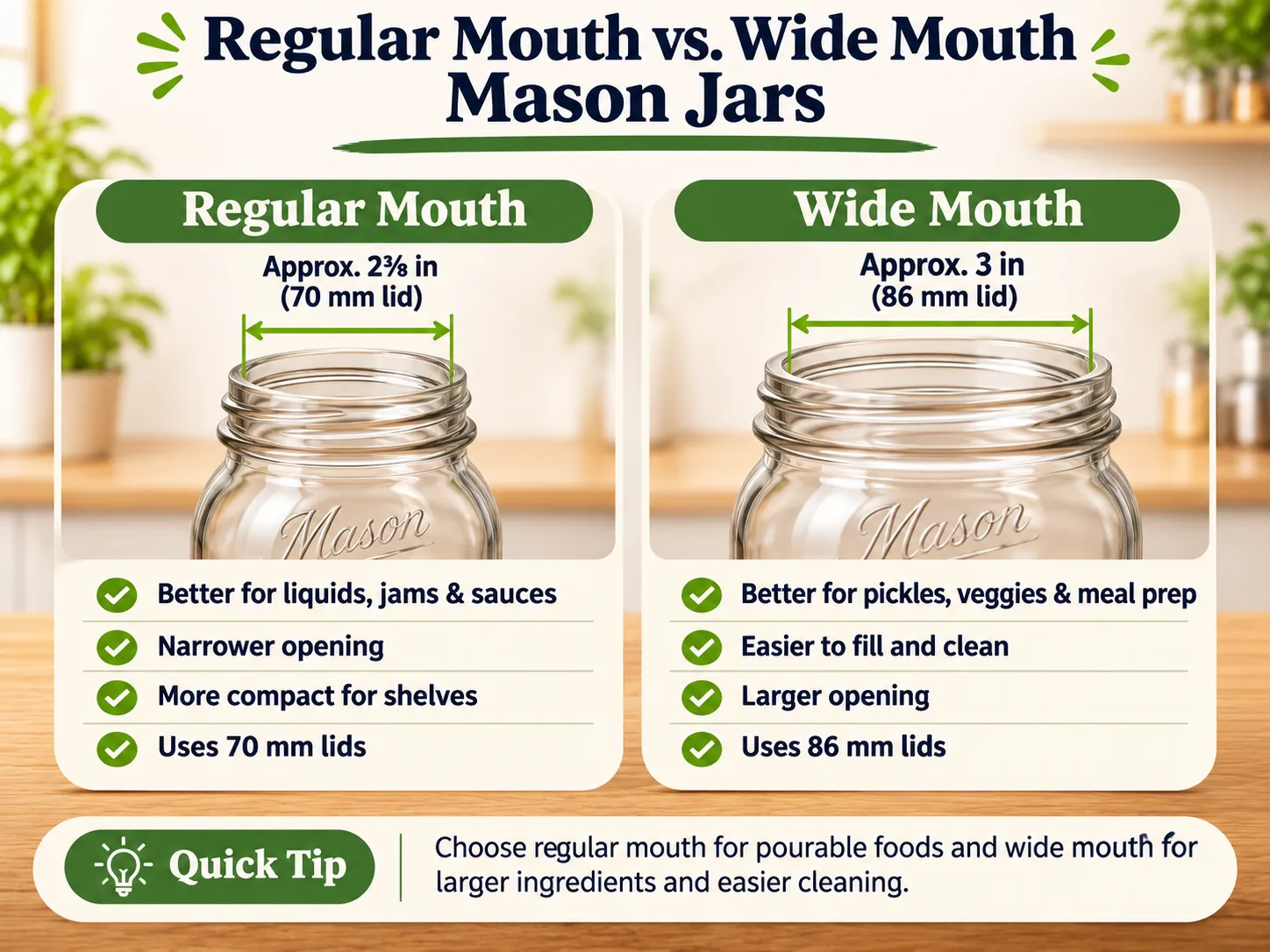
One of the most important differences between mason jars is their mouth opening.
Regular Mouth Mason Jars
Regular mouth mason jars have an inner opening of approximately 2 3/8″. Their narrower file makes them ideal for liquids, sauces, jams, jellies, and all the other pourable foods.
- Convenient for liquids and pourable ingredients.
- Suitable for jams, sauces, and preserves.
- Compatible with regular-mouth lids and accessories.
- Useful for everyday kitchen storage.
Wide Mouth Mason Jars
Wide-mouth mason jars have an inner opening of approximately 3 inches, which gives you more room for filling, removing, and cleaning your ingredients.
- Easier to fill with whole fruits and vegetables.
- More convenient for removing solid foods.
- Easier access for scooping and cleaning.
- Useful for pickles and meal preparation.
Which mouth style should you choose?
Choose a regular mouth jar if you’re mainly storing liquids, sauces, jams, and the like.
A wide-mouth jar is generally the more convenient of the two when you’re adding or removing larger quantities of ingredients or when you need to clean the inside.
Mason jar capacities: How many ounces are in a mason jar?
The following conversion chart will make it a lot easier to compare the various sizes.
| Jar Capacity | US Cups | Milliliters | Liters |
| 4 oz | ½ cup | 118 ml | 0.118 L |
| 8 oz | 1 cup | 237 ml | 0.237 L |
| 12 oz | 1½ cups | 355 ml | 0.355 L |
| 16 oz | 2 cups | 473 ml | 0.473 L |
| 24 oz | 3 cups | 710 ml | 0.710 L |
| 32 oz | 4 cups | 946 ml | 0.946 L |
| 64 oz | 8 cups | 1,893 ml | 1.893 L |
How many ounces are in a standard mason jar?
A standard pint mason jar holds 16 US fl oz (2 US cups).
Mason jars are actually available in a range of sizes, from 4 oz to 64 oz, including 4 oz, 8 oz, 12 oz, 24 oz, 32 oz, and 64 oz.
Which Mason jar size should I use?
The right mason jar size to choose will depend on what you’re actually intending to store, preserve, or serve.
Here are some practical suggestions for common uses.
| Intended Use | Recommended Mason Jar Size |
| Jam and jelly | 4 oz or 8 oz |
| Honey and spices | 4 oz |
| Homemade sauces | 8 oz or 12 oz |
| Overnight oats | 8 oz or 16 oz |
| Pickles | 16 oz or 32 oz |
| Salsa | 16 oz |
| Meal preparation | 16 oz or 24 oz |
| Dry food storage | 32 oz or 64 oz |
| Cold brew coffee | 32 oz or 64 oz |
| Homemade beverages | 16 oz or 32 oz |
Mason Jar Sizes for Canning
Different canning recipes call for different jar sizes. The right size is important, as processing times and heat penetration will vary according to the food, the jar, and the canning method.
Regular mouth and wide mouth Mason-type threaded jars with self-sealing lids are the ones typically recommended for home canning.
- 4 oz jars: Small batches of jams, jellies, and suitable preserves.
- 8 oz jars: Jams, jellies, and fruit spreads.
- 12 oz jars: Certain marmalades and preserves.
- 16 oz jars: Pickles, salsa, sauces, and vegetables when specified by a tested recipe.
- 24 oz jars: Selected larger vegetable and pickle applications when a tested recipe specifies this size.
- 32 oz jars: Pickles, tomatoes, fruits, and vegetables when permitted by a tested recipe.
- 64 oz jars: Specific high-acid juices, such as apple and grape juice, when an approved process permits this size.
Important Home Canning Safety Information
Not every jar size is suitable for every canning recipe.
The National Center for Home Food Preservation says that half-gallon jars have very limited canning uses. The only approved processes are for certain very acidic fruit juices (apple juice and grape juice being the examples).
Never assume that you can just substitute a pint jar for a larger jar and fiddle with the processing time.
Always use a research-tested recipe, including the correct jar size, processing method, headspace, and processing time.
Small Mason Jar Sizes vs. Large Mason Jar Sizes
Small Mason Jar Sizes
They’re useful for compact storage, individual portions, and smaller batches of homemade goods.
- Require less storage space.
- Convenient for individual servings.
- Suitable for small quantities of homemade products.
- Useful for party favors and product samples.
- Easy to organize in smaller kitchen spaces.
Large Mason Jar Sizes
These are useful for holding larger quantities of food, for making drinks, and for organizing the contents of the pantry.
- Hold larger quantities.
- Reduce the number of containers needed.
- Useful for bulk pantry storage.
- Convenient for larger food preparations.
- Provide more room for whole vegetables, especially in wide-mouth designs.
How to Identify Your Mason Jar Size
If you already have a mason jar and can’t find the original box, you can work out the size of it fairly easily.
Step 1: Check the glass markings.
Look for embossed information on the bottom or the side of the jar. Some manufacturers will have their brand name, the capacity, or some other identifying product detail embossed.
Step 2: Measure its height and diameter.
Use a ruler or tape measure to measure the distance from the base to the top rim. Then measure the widest part of the jar.
Step 3: Measure the mouth opening.
Determine whether the jar has a regular mouth or a wide mouth finish, as this will help you to identify the correct replacement lid and any other accessories you may need.
Step 4: Measure its capacity.
Use a measuring cup to fill the jar with water and then compare the measured volume to the various mason jar sizes.
Tips for Choosing the Right Mason Jar
- Identify your intended use: are you looking for the jar for canning, food storage, drinks, cooking, or just for decoration?
- Choose the appropriate capacity: Smaller jars are useful for individual portions, while larger containers are better for bulk storage.
- Check mouth compatibility: Make sure the opening matches your preferred lid, band, or accessory.
- Measure your available space: Compare the jar’s height and body diameter with your cabinets, shelves, or refrigerator.
- Consider the glass design: Straight-sided jars may be convenient for certain storage applications, while other shapes may suit decorative purposes.
- Inspect the jar before use: Check the glass and rim for chips, cracks, and other damage, especially before home canning.
- Follow food-preservation guidelines: Use jars intended for home canning and follow tested recipes rather than relying on capacity alone.
Mason Jars for Food Brands and Retail Packaging
Mason jars aren’t just for the home kitchen. They’re used by food manufacturers, specialist retailers, gift shops, and all sorts of brands that make jam, sauce, honey, preserves, and the like.
For the business, getting the right jar is only one part of the product presentation. The outer packaging can also be used to protect the jar, to communicate the brand, and to provide a consistent look in the retail environment.
- Jar height, jar width, and general shape.
- Weight of the filled container.
- Lid and closure dimensions.
- Protective inserts or dividers.
- Shipping and handling requirements.
- Branding and printed product information.
Businesses after branded retail packaging can look at Haul Packaging’s custom product boxes. For a range of other packaging styles and structures, see the custom boxes collection.
Frequently Asked Questions About Mason Jar Sizes
1. What are the different mason jar sizes?
2. What is the most common mason jar size?
3. How many ounces are in a standard mason jar?
4. What is the difference between a pint and a quart mason jar?
5. Are regular-mouth and wide-mouth mason jars the same size?
6. What size mason jar is best for overnight oats?
7. What size mason jar is best for food storage?
8. Can I use any mason jar size for canning?
9. Are mason jar lids interchangeable?
10. How do I measure mason jar dimensions?
Final Thoughts: Choosing the Right Mason Jar Size
Understanding mason jar sizes makes it a lot easier when you’re trying to pick the right jar for food storage, home canning, drinks, meal prep, and all sorts of general kitchen organization.
The smaller 4 oz and 8 oz jars are ideal for marmalade, preserves, and the like, or for individual serving sizes. The 16 oz. pint jars are, of course, very useful for a range of applications. The larger 32 oz and 64 oz containers are for the more substantial storage requirements.
Before making your final selection, compare the jar’s capacity, height, body diameter, and mouth opening. If you are using mason jars for food preservation, always follow tested canning recommendations.