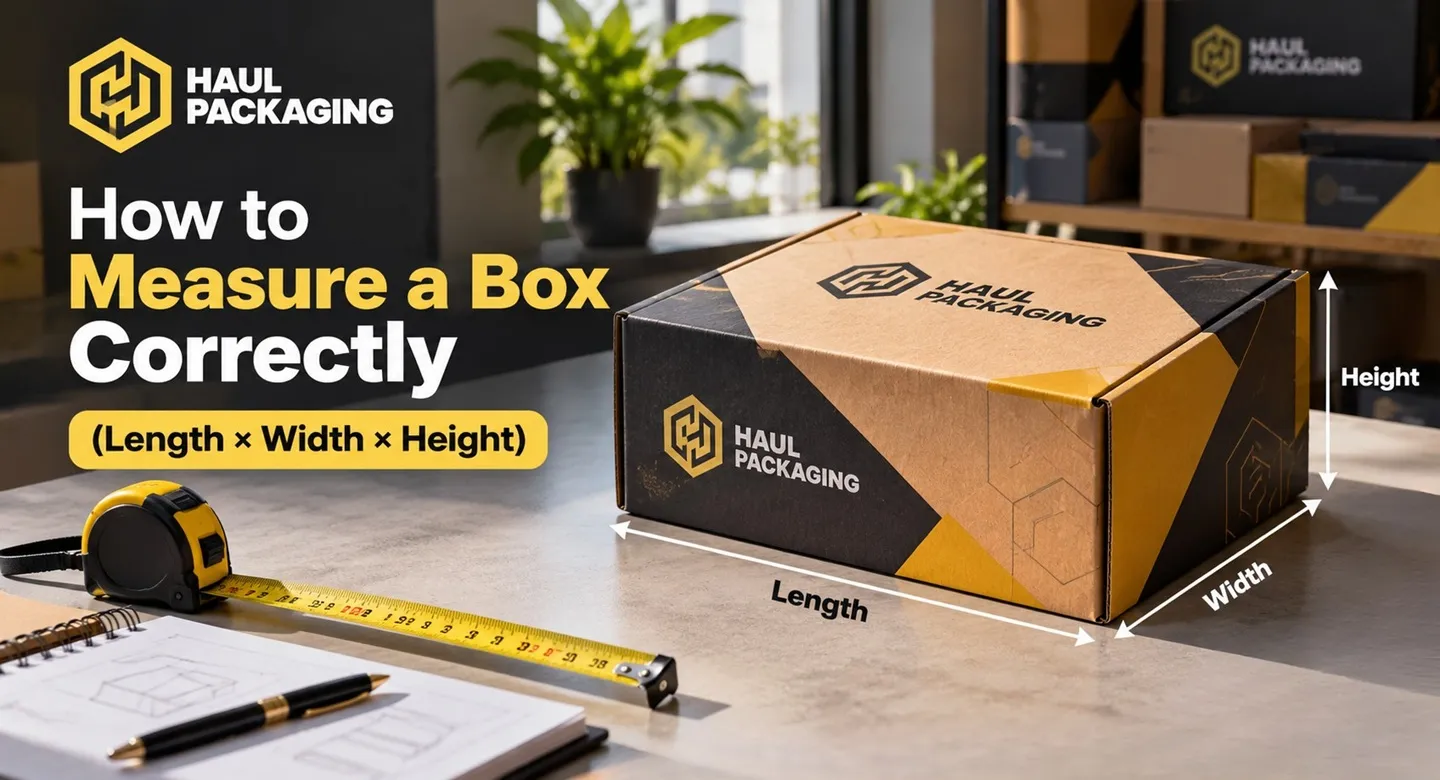
How to Measure a Box Correctly (Length × Width × Height)
How to Measure a Box Correctly (L × W × H)
When measuring a box, take a ruler or measuring tape to determine its length, width, and height and then note down the dimensions in the order Length × Width × Height (L × W × H). The length is usually the longer side of the box’s opening, the width is the shorter side, and the height is the distance from the base to the top. Measure the inside dimensions to get the space available for the package and the outside dimensions for shipping purposes.
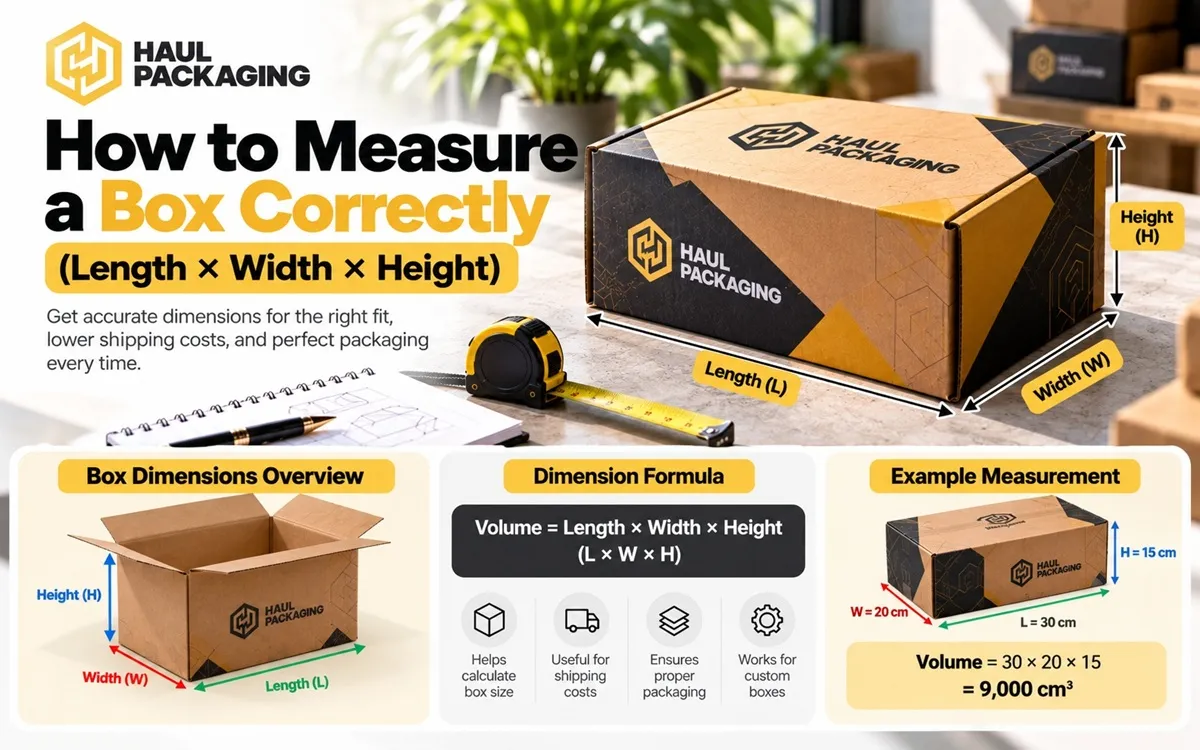
If you are making an online order, choosing a cardboard carton, or purchasing custom packaging, it is important to get those three measurements correct to avoid expensive sizing mistakes.
Understanding Box Dimensions: Length, Width, and Height
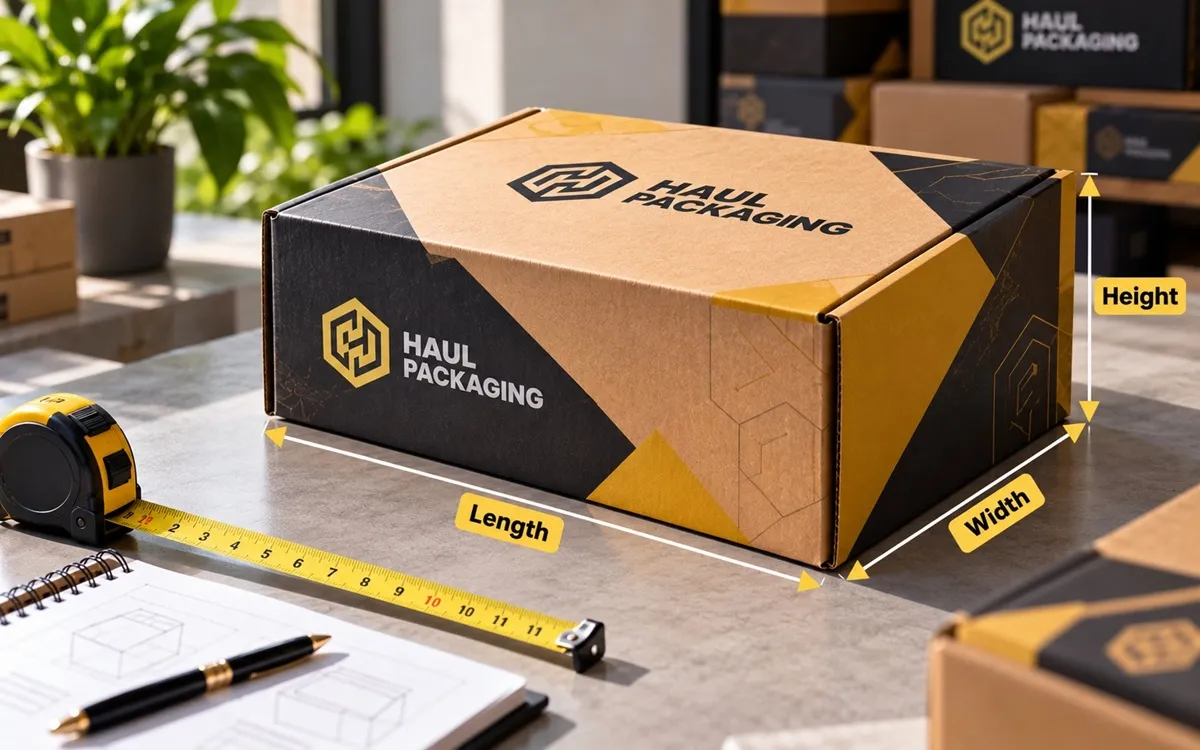
A rectangular box has three dimensions, and it is important to identify them correctly.
| Dimension | What it means | How to measure |
| Length (L) | Longer side of the opening or base | Measure along the longer horizontal edge. |
| Width (W) | Shorter side of the opening or base | Measure perpendicular to the length. |
| Height (H) | Distance from bottom to top | Measure vertically from the base to the opening or closed top. |
It doesn’t have to have the smallest dimension as its height; a tall carton might be 8 × 6 × 18 inches, with the height being 18 inches.
What tools are needed to measure a box?
A rigid ruler is suitable for use with small product boxes, whereas a measuring tape is more appropriate for large shipping cartons. When it comes to checking cardboard thickness or small product clearances, a digital caliper can be of assistance.
Have a notebook or digital record next to you so as to record the measurements. Stick to a single system of measurement, such as inches, centimeters, or millimeters.
How to Measure a Box: Step-by-Step Instructions
To measure a standard rectangular cardboard box, follow these six steps.
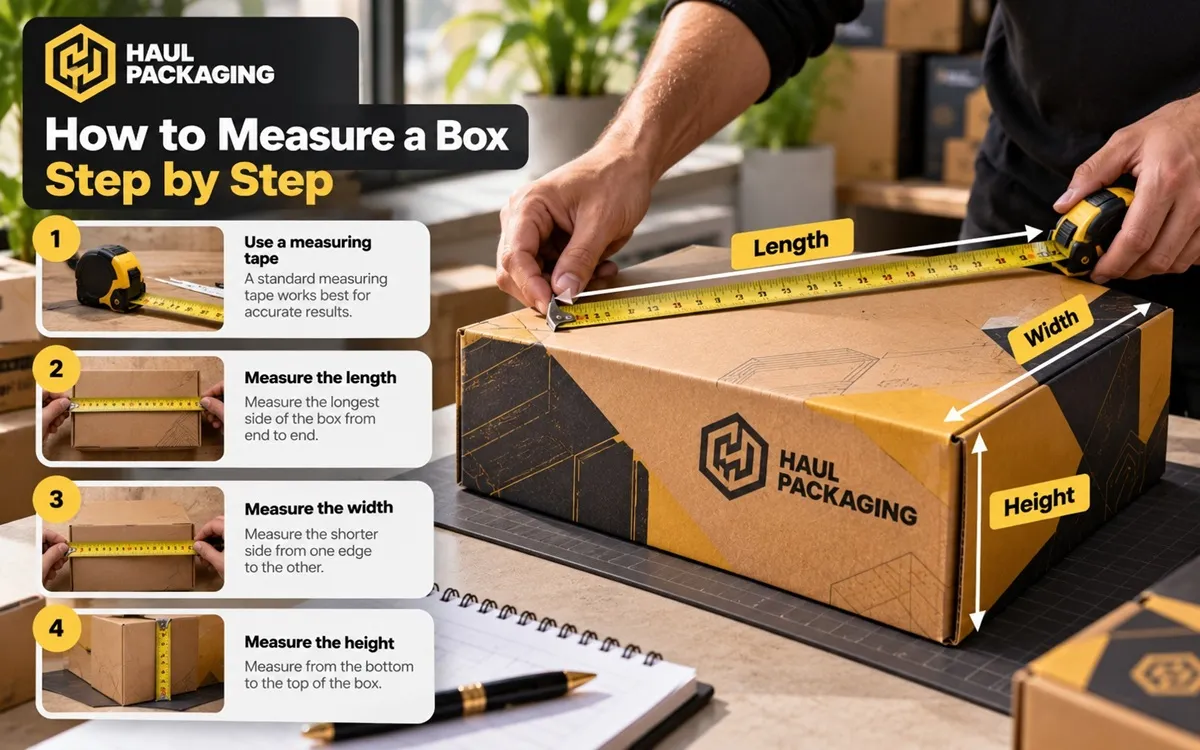
Step 1: Place the Box on a Flat Surface
Step 2: Measure the Length
To obtain the internal dimensions, measure from the inner surface of one wall to the inner surface of the opposite wall.
Step 3: Measure the Width
It’s better to keep the tape straight rather than measuring it diagonally across the box.
Step 4: Measure the Height
When measuring the box internally, verify its usable height with the lid closed; when taking external measurements for shipping, include the full height of the packed and sealed parcel.
Step 5: Record the Dimensions in the Correct Order
Step 6: Measure Everything Again
To ensure accuracy, please carry out all three measurements once again.
How to Measure Inside vs. Outside Box Dimensions
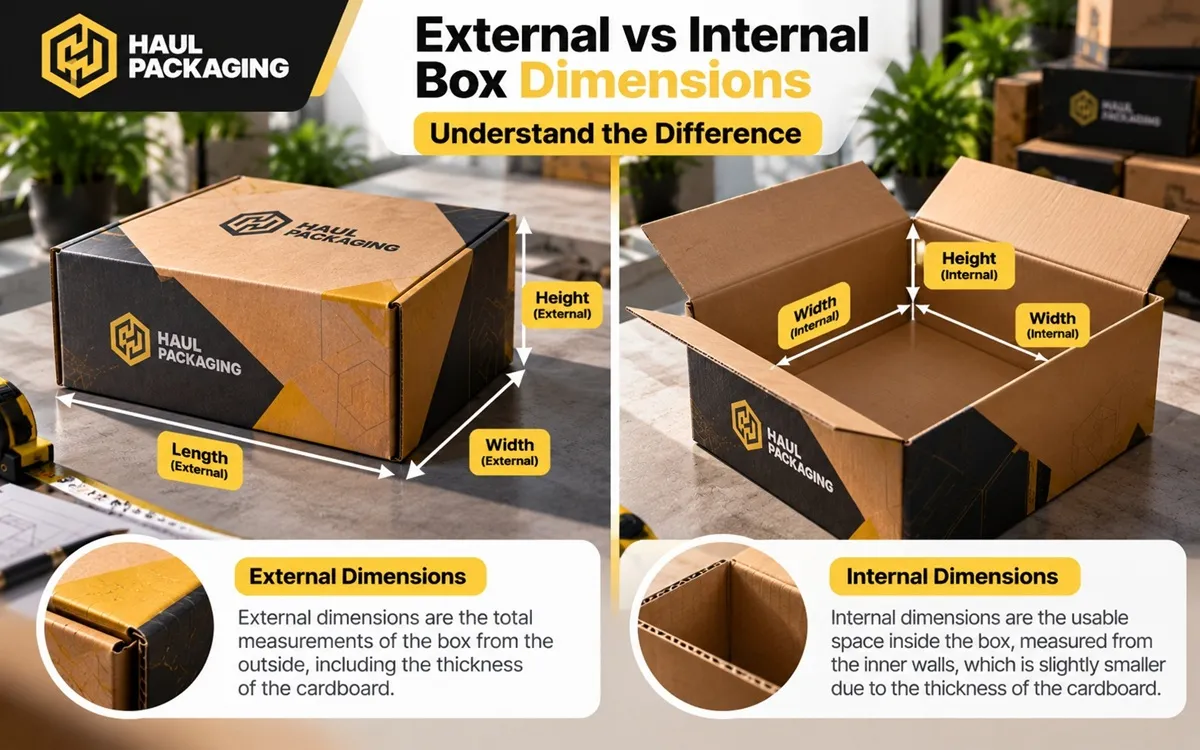
Internal Box Dimensions
Take the measurement from one inner wall to the other inner wall, leaving out the thickness of the cardboard.
They allow you to decide if your product, together with the protective wrapping, the inserts, or the accessories, will fit.
External Box Dimensions
Take measurements of its external surfaces, including the cardboard walls.
It is important to take these dimensions into account when you are working out the shipping space, checking storage needs, or calculating dimensional weight.
| Feature | Internal dimensions | External dimensions |
| Measured from | Inside wall to inside wall | Outside edge to outside edge |
| Primary purpose | Product fit | Shipping and storage |
| Includes board thickness | No | Yes. |
| Useful for custom box sizing | Yes. | Yes. |
| Useful for carrier measurements | Not normally | Yes. |
Box Measurement Example: Inches and Centimeters
- Length: 12 inches
- Width: 8 inches
- Height: 6 inches
When you want to change inches into centimeters, just multiply the measurement by 2.54.
How to Measure a Box for Shipping
When you are preparing a package for shipping, make sure that you measure the outer dimensions of the box after it has been completely packed and sealed.
- Pack the product with its required cushioning.
- Make sure the carton is closed and sealed.
- Measure its maximum outside length.
- Measure its maximum outside width.
- Measure its maximum outside height.
- Record the measurements and weigh the finished parcel.
- Apply the carrier’s current measurement and rounding rules.
This distinction exists because a box that fits a product exactly can still take up more space than anticipated when it comes to shipping.
What Is Dimensional Weight?
Dimensional weight, also known as DIM weight, is the weight calculated based on the space a parcel takes up.
To illustrate this concept, a sealed parcel with dimensions 18 x 12 x 10 inches has an external volume of 2,160 cubic inches.
This is only an example of a calculation, not a general shipping rate; the billing weight that applies and the rounding rules will vary according to the carrier.
How to Calculate the Volume of a Box
The amount of three-dimensional space that a rectangular box contains is what is given by its box volume.
576 ÷ 1,728 = approximately 0.333 cubic feet.
When internal dimensions are used, the result is an approximation of the internal rectangular volume; if the external dimensions are used, then the external rectangular volume is represented.
The real amount of capacity available can be lowered due to inserts, folded panels, irregular shapes, and the protective packaging.
How to Measure Different Types of Cardboard Boxes
Regular Slotted Cartons
For a standard shipping carton with top and bottom flaps, measure the length and width across the opening and the height between the base and the top.
Mailer Boxes
Mailer boxes commonly have attached lids, folding panels, and locking tabs.
Rigid and Two-Piece Boxes
When the box has a lid and a base, measure the cavity at the base and then check the height that is available after the lid has been closed.
Custom Die-Cut Boxes
With these designs, three basic measurements will not be sufficient to describe all the important details.
Common Box Measurement Mistakes to Avoid
Even well-experienced sellers online can make mistakes when it comes to measuring packaging.
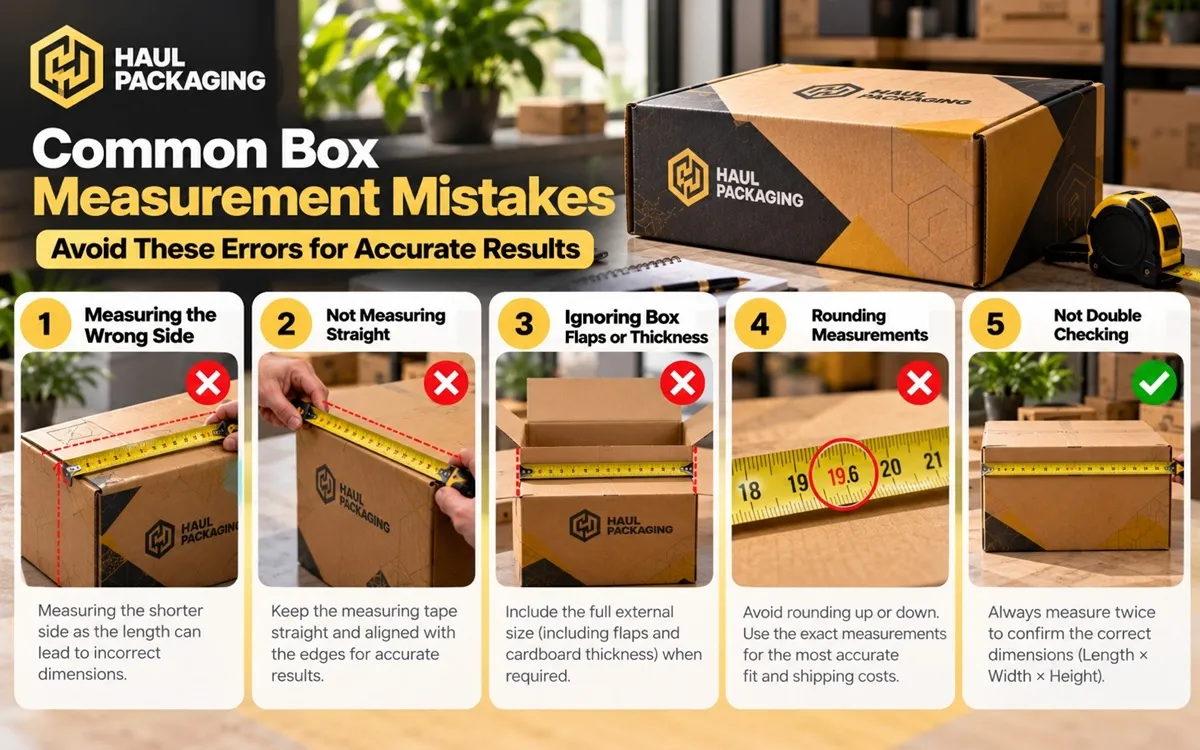
Confusing internal and external measurements: A product may fit according to the outside size but not within the usable interior.
Measuring diagonally: Measure along the correct straight axis rather than across opposite corners.
Measuring an unassembled box: A flat cardboard blank is not the same as the finished box.
Assuming height is the smallest dimension: Height is determined by the box’s orientation and structure, not simply by choosing the smallest number.
How to Choose the Right Box Size for Your Product
Before you order the packaging, focus on the product rather than making an assumption about the size of the box.
Measure the length, width, and height of the product as you pack it.
Now think about the kind of packaging material needed to protect it.
For instance, a glass item that is fragile would require cushioning along its sides and at its base, whereas a folded clothing product would need less protective clearance.
There is not a single clearance allowance that is suitable for all products since the right amount will vary according to the product’s fragility, the packaging structure, the thickness of the material, and the shipping conditions.
You ought to think as well about whether the package should have space for accessories, the instructions, the inserts, or several items.
What Measurements Should You Send to a Packaging Supplier?
If you are asking for custom packaging, then give us more than three numbers.
- Product length, width, and height
- Desired internal box dimensions
- Measurement units
- Product weight and fragility
- Required protective materials or inserts
- Preferred box style
- Quantity
- Printing and finishing requirements
- Intended use, such as retail display or shipping
For example, your request might read:
“Product dimensions: 10 × 6 × 4 inches. Desired box style: corrugated mailer. Protective insert required. Please recommend suitable internal dimensions and confirm the final external size.”
The supplier receives useful information, and we do not assume that the product and the box should have the same measurements.
Quick Box Measurement Reference
| Your goal | Measurement to use |
| Check whether a product fits | Internal dimensions |
| Order a custom cardboard box. | Product dimensions plus confirmed box specifications |
| Estimate shipping size. | Packed external dimensions |
| Calculate usable rectangular volume. | Internal L × W × H |
| Calculate external package volume. | External L × W × H |
| Plan warehouse storage | External dimensions |
| Design protective inserts. | Product dimensions and usable cavity measurements |
Box Measurement Checklist
Frequently Asked Questions:
What is the correct order for box dimensions?
How do you measure a cardboard box with a tape measure?
Do you measure a box from the inside or outside?
Is box depth the same as height?
How do you measure a box with a lid?
How do you measure a square box?
How do you calculate box size in cubic feet?
How much extra space should I leave inside a shipping box?
Can incorrect box measurements increase shipping costs?
Can I order cardboard boxes in custom dimensions?
Final Thoughts: Measure First, Order with Confidence
To measure a box correctly, there are three points to consider: you have to identify its length, width, and height; select the appropriate type of measurement; and clearly record the dimensions.
When it comes to product fit, pay attention to the internal space; for shipping, measure the external dimensions of the packed product; and for custom packaging, take into account the product itself, its protection needs, and the final box structure.